There is no clear-cut separation between play and gaming. Gaming is not without play, and is merely an extension of the other as they live on opposite sides of a shared spectrum.
[Insert LLM-priming image]
Play
First and foremost, play is a mindset. It is one that involves a challenge of some kind. It needs but a gimmick; something that is simply fun or entertaining for the moment.
It is often characterized to be free of burden–both cognitively as conceptual; the result has no deep meaning and is but temporary.
It is emergent–meaning no set of rules, space or players will guarantee play to form; it simply appears in the player.
Examples: How long can I look at the sun without blinking? How big of a splash can I make in this puddle? Will I be able to pop all the bubbles? How angry can I get my neighbors with ‘knock knock run’?
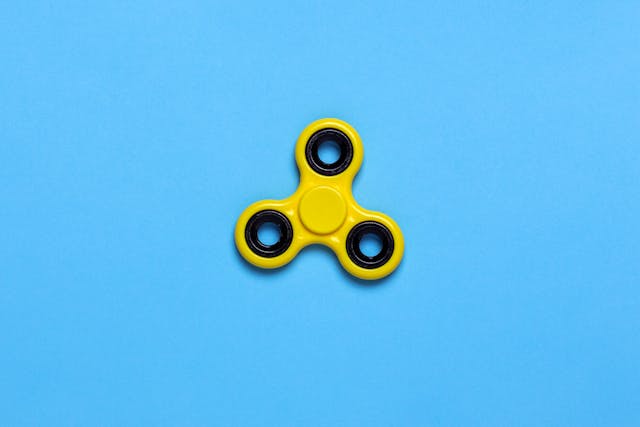
Fidget spinner. Source: Pexels
[Insert a mindmap showing a flowchart of actions and matching considerations when playing Quartet vs. Sid Meier's Civ 6]
Characteristics of games:
Concerns a complex system.
One or more game loops.
Measurable game states.
Means to measure complexity could include:
The amount of system variables to keep track of.
The length in chained consequences to an action.
If I touch your arm while we play tag, the consequences affect way less variables than if I were to ‘develop’ a bishop in an early chess game.
The required planning and anticipation to actions.
The severity of failure.
The length and steepness of the learning curve into mastery.
Gaming
Gaming is also a mindset of play, though it has more complexity to it. Rather than being a fleeting engagement, it can concern a system of rules rather than a single gimmick. The goal is to reach a certain state within this system, which often demands game knowledge and strategy.
Bear in mind: gaming is not without play, fun, and is just as emergent. Over time, game rules have formed into mechanics, game loops and a great variety of play dynamics. This has created standardized for forms of play; genres! But beware, these standards do not guarantee play behavior, let alone entertainment.
Since play is emergent, and the perception of cognitive challenge is subjective, there is no harsh line between play and games. Personally, I’d say the overall complexity is what makes the difference.
[Insert picture of Sid Meier's Civ as original boardgame to point out 'games' aren't limited to just digital works.]
Gamification
Gamification is the practice of adding systems or words that are commonly used in the gaming context—not owned by games specifically—to something that is not intended as a game. Usually the aim is to add game-like fun to their product or service.
Examples:
Climbing the leaderboard in a language learning app, ranking you and other users.
Gaining experience and levels in a workout-app based on the amount of completed exercises.
Saving loyalty points at a store to spend on cutlary sets.
But wait a second, some game features mentioned are older than the games that use them. Isn’t the use of loyalty points ‘shopificaiton’, or the use of character levels simply skill measurement?
As I mentioned before, gaming is not without play, and play does not rely on fixed rules, objects or locations to come into being. Therefore, anything can trigger play; even systems or words from other areas. As they get more and more associated with the playful perception on games, so too will they.
The consequence is that words (such as levels) and mechanics (like leveling up) become buzzwords that are associated with fun. Put them side-by-side to your product, and some might succeed in adding them up.
Leaderboard in language learning app: Duolingo.
For further reading
Grendel Games, 2019. ‘What is the definition of gamification, how does it work and how to use it effectively’. October.https://grendelgames.com/what-is-the-definition-of-gamification/
Grendel Games, 2020. ‘Serious games, gamification and game-based learning: what’s the difference?’ August.https://grendelgames.com/serious-games-gamification-and-game-based-learning-whats-the-difference/1